
Probiotics - some substance beyond the marketing
Introduction
With the global probiotic market worth some US$32bn it’s not surprising that probiotics seem to be everywhere and included in everything.
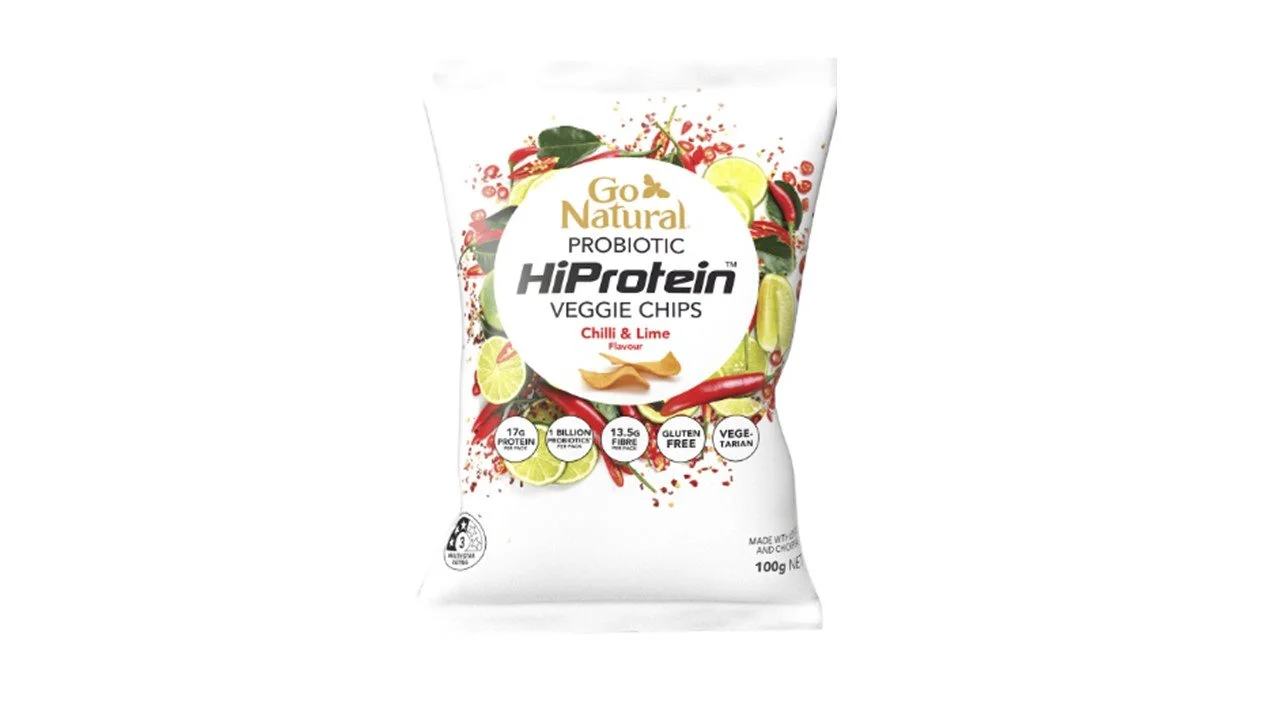
These chips include probiotics and get extra marketing points for amping that other zeitgeisty nutrient, protein.
On the one hand, the suggested applications of probiotics greatly forerun scientific evidence, but, on the other, they’re readily available and safe for most people.* (Ref) And there’s good evidence that they can help with diarrhoea caused by a range of factors; they are generally accepted as useful in reducing the symptoms of irritable bowel syndrome (IBS); and they have application in the management of fatty liver disease. There are many (so many) other conditions where evidence is poor, but that’s not to say probiotics are categorically useless, just that research hasn’t yet demonstrated that they’re useful.
Before we go any further though, prebiotics, discussed in the last article, are much better established as a means to optimise gut flora and should be part of everyday nutrition, while probiotics probably won’t do much unless your microbiome is in a state of disruption, or dysbiosis, in which case specific strains can be helpful for specific conditions (we’ll get to that).
*The exceptions might be the seriously immunocompromised, newborns and the very ill. Even so, here probiotics might still be indicated, though prescribed judiciously as they run the risk of escaping the gut to cause systemic infection. (Ref)
How do probiotics work?
To summarise a complex area evidence suggests:
Their transitory presence, along with the bioactive compounds they release, can boost the local gastrointestinal immune system and may also benefit systemic immunity.
They temporarily crowd out pathogenic microbes and promote a more anaerobic and more acidic gut environment, which favours beneficial microbes.
In limited circumstances, they may even colonise the gut directly. This, however is not the main game. Think of it as fertilising your garden, not replanting it with seedlings! (Ref)
Beyond genus and species: strain matters
It’s tempting to think different strains within the same species must be interchangeable. But this is not the case, as different strains can have quite different actions.
| Genus | Species | Strain | Action |
|---|---|---|---|
| Limosilactobacillus* | reuteri | DSM 17938 | Influences gut nervous system signalling to reduce sensitivity. |
| Limosilactobacillus* | reuteri | ATCC PTA 6475 | Has genes which may modulate systemic immunity. |
*Limosilactobacillus was previously Lactobacillus. In 2020, the Lactobacillus genus was subdivided up into 23 new genera, but you’ll still see the term Lactobacillus more often that not, though technically retired. (Ref, Ref)
Probiotic clinical trials assess specific strains in specific patient groups at specific doses and for specific durations. If you’re aiming for the same results, you need to seek out the same strains, ideally match the patient groups to yourself (for instance by age and symptoms) and take the same doses. Moreover, you should seek products that contain the tested strains only. More is not always better. (Ref) This sounds like a lot of work but it’s doable, as we’ll see.
When can probiotics help me?
There is a little bit of evidence for many conditions but most of it not very compelling. Evidence is strongest for gastrointestinal complaints but even here various expert groups differ somewhat in their views. (Ref) One such group, The World Gastroenterology Organisation (WGO) published a collation of currently available scientific evidence in 2023. Their findings were as follows
Conditions where there is at least moderate evidence of effectiveness:
Acute infectious diarrhoea in children if administered early
Prevention of antibiotic-associated diarrhoea in adults and children when administered for the duration of antibiotic therapy
Preventing C. difficile associated diarrhoea in patients receiving antibiotics
Prevention of radiation-induced diarrhoea
Reducing gastrointestinal side effects caused by Helicobacter pylori antibiotic treatment
Preventing initial and recurring mild pouchitis in adults and children
Reduction of Irritable Bowel Syndrome (IBS) symptoms, with strain-specific effects evident for different symptoms
Reduced crying time due in breastfed infants with colic
Lactose malabsorption
Necrotising enterocolitis in pre-term babies
Non-alcoholic fatty liver disease in adults and children
Functional constipation in children
Conditions where there is some evidence
Acute infectious diarrhoea in adults if administered early
Treatment of hepatic encephalopathy
Induce remission in mild to moderate ulcerative colitis in adults and children
Conditions where evidence is lacking
Colorectal cancer prevention
Crohn’s disease
Prevention of systemic infections in critically ill patients
Everything else
But there are so many! Which should I take?
While many preparations contain multiple strains, generally a single strain will suffice. (Ref) And, of course, it’s easier to find a single strain in the correct dose, than to find a product which exactly matches the strains in the correct doses as a clinical trial.
Fortunately, the WGO has done lot of the work for us. Their guidelines include a comprehensive list of probiotics indicated for various conditions along with the strength of the evidence. In almost every case, single strains are supported by equivalent or stronger evidence than multi-strain products. You can see more results here but a subset of probiotics tested for the management of various diarrhoea-related conditions finds Lacticaseibacillus rhamnosus GG (often still Lactobacillus rhamnosus GG) and the yeast Saccharomyces boulardii CNCM I-745 were consistently the most effective or at least equivalently effective as other probiotics. The strength of evidence was however generally only modest in adults, though better supported in children.
| Strain | L. rhamnosus GG | S. boulardii CNCM I-745 |
|---|---|---|
| Dose (as available) | Dose (as available) | |
| Treatment of acute diarrhoea in adults and children | 10 billion CFU twice daily for 7 days | 5 billion CFU twice daily for 7 days |
| Antibiotic-associated diarrhoea in adults and children | children >5 billion CFU, adults 10 billion cfu, twice daily for duration of antibiotic treatment. | 5 billion CFU twice daily for duration of antibiotic treatment. |
| Prevention of Clostridium difficile associated diarrhoea in adults and children | Not supported | 10 billion CFU twice daily |
| Coadjuvant therapy for Helicobacter pylori treatment in adults and children | 6 billion CFU twice daily for duration of antibiotic treatment. | 5 billion CFU twice daily for duration of antibiotic treatment. |
| Strain | Dose (CFU) | IBS symptom |
|---|---|---|
| Bifidobacterium bifidum MIMBb75 | 1 billion once daily | QoL score improvement |
| Lactobacillus plantarum 299v (DSM 9843) | 1 billion once daily | Abdominal pain and bloating |
| Bifidobacterium infantis 35624* | 10 billion once daily | Global symptom improvement |
| Lactobacillus reuteri DSM 17938 | 0.1 billion twice daily | Functional constipation |
| Bacillus coagulans Unique IS-2 | 2 billion daily | Global symptoms |
Data Source: The World Gastroenterology Organisation (2023). (Ref); www.ibsprobiotics.org (Ref)
How do I know I’m buying the real deal?
With the modern miracles of freeze-drying and encapsulation advances, many probiotics won’t need refrigeration. So, unless you buy something from the pharmacy fridge (and there’s no need) consumers don’t have to worry about whether the cold-chain was maintained throughout storage and transport and the viability of the end-product.
In addition, in 2025, Australia’s drug regulator, the Therapeutic Goods Association (TGA) released guidelines to ensure probiotic quality, which are closely aligned with those of the WGO. Summarised in the graphic.
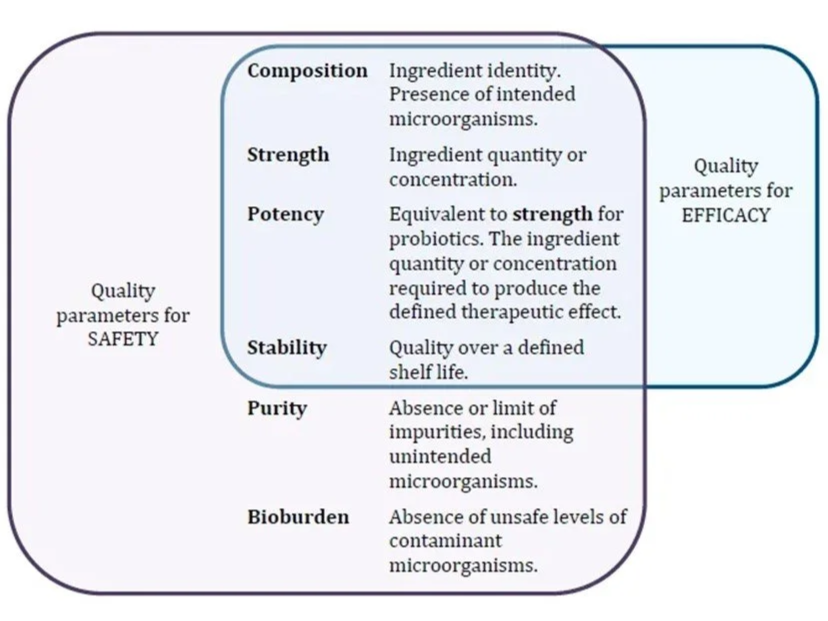
The Therapeutic Good Association has released quality control guidelines for probiotics.
The TGA asks that:
“Sponsors should identify the active ingredients in the final product at strain level”. Previously, most probiotics were only listed at the species level, but, as we know, strain matters.
That the “quantity of each active ingredient in the final product is no less than the stated content throughout the shelf life of the product”. So consumers know they’re still getting the right dose up until expiration.
“Over its shelf life [the probiotic] … remains, and can be expected to remain, within its specifications under the labelled storage conditions.” This refers to bacterial count but also means storage conditions need to be explicit too.
A side bar on medicines and the Therapeutic Goods Association (TGA):
All approved probiotics on the TGA database have Listed status, which ensures products are true-to-label and permits more generic health claims without the requirement for the rigorous scientific evidence required for Registered medicines. Almost all supplements are also Listed rather than Registered.* (Ref)
TGA-approved products include the TGA number on the label , with ‘L’ denoting a Listed Product and ‘R’ a Registered product.
All products that make any health claim should be registered with the TGA but, in the days of online shipping, you can buy many which are not, though you forego the TGA’s quality control. You can search for products with the TGA here: Australian Register of Therapeutic Goods (ARTG) or look for the label number on the pack.
Registered supplements are commonly vitamins and minerals that have been sold for many years with well clarified benefits in specific groups, such as iron, vitamin D, calcium and folic acid.
Sourcing your probiotics
Finding the probiotics we want is not always easy. Here are my best efforts to track down the best options in Australia for you.
For various diarrhoea indications:
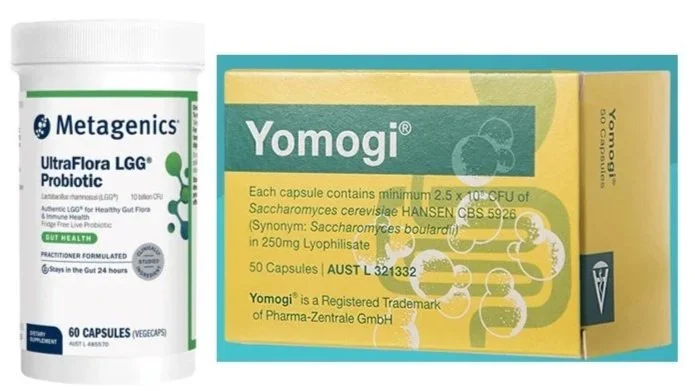
Evidence-backed probiotics for diarrhoea
Lactobacillus rhamnosis LGG: Amongst probiotics, LGG shows particularly good adherence to the large intestinal mucosa and thus may be a better coloniser than most if the gut flora is truly depleted by antibiotics. (Ref) The strain itself is variably susceptible to antibiotics but is still effective even when dead. (Ref, Ref)
There are a few pure strain formulations available in Australia. Metagenics Ultra Flora LGG (TGA Listed number: L 485570) is a reputable brand and cheaper than the other options. Also, it’s Listed with the TGA and available online and in many chemists - which may be handy when we’re talking diarrhoea.
Saccharomyces boulardii CNCM I-745: This one is harder. Yomogi Saccharomyces boulardii (L 321332) is the only formulation in Australia and is Listed with the TGA. The TGA listing requires the minimum CFU at end of shelf life be displayed on the pack, which, in this case is 250 million CFU (after a three year shelf life). The minimum CFU at batch release is 2.5 billion (in fact the company tells me the current batches of Yomogi were released at 7.2 billion CFU), which is fine to deliver the 5 billion twice a day we need for most diarrhoea indications. I suspect the 250 million is a very cautious estimate (it’s a German company), never the less, you may need to adjust the dose based on how long the product has been sitting in your bathroom cabinet, which may not be ideal.
It’s interesting also to note that, while the clinical results hold regardless, as a yeast, it isn’t killed by antibiotics, which is elegant.
IBS indicated probiotics
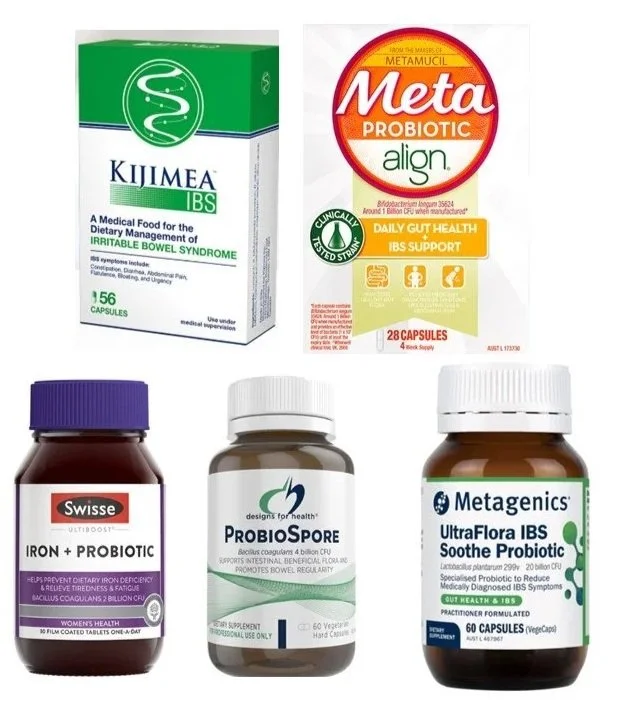
A line up of IBS probiotics
Bifidobacterium bifidum MIMBb75: This is sold under the German-based Kijimea brand. Clinical evidence is more substantive for the heat-inactivated form and this is not easy to get in Australia (which perhaps explains the low-level online hype around it). It’s also quite expensive at $182 for 84 capsules and it’s not TGA approved, though the German parent company may offer some assurance. Finally, note that there is no colony forming unit (cfu) information on the pack (because the bacteria are dead, so let’s call this a postbiotic), however 2 capsules daily is equivalent to clinical trial doses.
Lactobacillus plantarum 299v: This one was easy. Metagenics UltraFlora IBS Soothe L 346030.
Bifidobacterium longum subsp. infantis 35624 is now called Bifidobacterium longum subsp. longum 35624. You can buy it under the Metamucil brand.
This product has the same issue as Yomagi, where the CFU at release is 1 billion CFU and, at expiry, 10 million CFU. The WGO recommends 10 billion CFU daily for for IBS, though other clinical trials, showed it was effective at 100 million CFU. (Ref)
Bacillus coagulans MTCC 5260: Sold as Unique IS-2. While not a consensus view, it ranks particularly highly on this database, supported by linked research. A very attractive aspect is its tested effectiveness on nearly every symptom of IBS in both sexes; in both adults and children; and regardless of whether the IBS is of the diarrhoea or constipation variety, or both. (Ref, Ref)
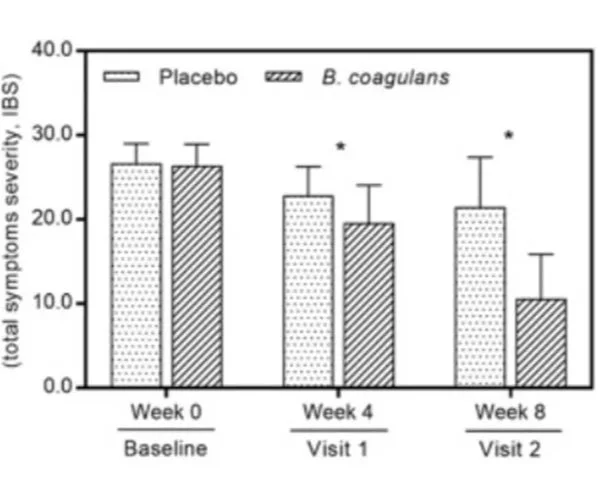
Mean adult symptom severity score of IBS after B. coagulans Unique IS-2. See the placebo effect also in evidence here . Madempudi et al (2019). (Ref)
Swisse sells it but to achieve 2bn CFU, you’d need 4 capsules of the vitamin C version (L 345126) , which puts at twice the advised limit for vitamin C (before you even eat any other food). (Ref) The iron version (L 345770) gives you the right dose in a single capsule but iron supplementation is only a good idea if you are iron deficient, as excess iron can cause oxidative stress. (Ref)
There is only one other single strain of Unique IS2 for sale in Australia and it’s also registered with the Therapeutic Goods Association (TGA). One capsule has 4bn CFU, which is fine. You can buy it here.
| Cost /pack | Dose | Cost /day | TGA number | |
|---|---|---|---|---|
| Metagenics UltraFlora LGG probiotic | $56.95 | 1 cap 2x daily | $1.90 | L485570 |
| Yomogi | $16.95 | 2 caps 2x daily | $3.39 | L321332 |
| Kijimea | $182.33 | 2 cap 1x daily | $4.34 | None |
| Metagenics UltraFlora IBS Soothe Probiotic | $61.95 | 1 cap 1x daily | $1.03 | L467967 |
| Meta Probiotic Align | $50.39 | 1 cap 1x daily | $1.80 | L485129 |
| Swisse Iron + Probiotic | $24.99 | 1 cap 1x daily | $0.83 | L345770 |
| Probiospore | $64.96 | 2 cap 1x daily | $1.08 | L474865 |
Conclusion
The evidence for probiotics continues to evolve. It’s likely that all of us have suboptimal microbiota but no benchmark standard has been established, while microbiota measurement is not very exact as it’s generally by stool sample and therefore only represents the distal colon inhabitants. (Ref) For now then, individualised probiotic prescriptions to fit your gut and your life are not something you should be paying for. As machine learning evolves and collection measures improve, our understanding will gain nuance and more applications are bound to emerge. For now, judicious use of specific strains of probiotics for established indications, along with a diet rich in prebiotics, is your best bet.
